
A Second Residency as Plan B
A second residency is leverage, not an escape hatch. This companion guide walks through Panama's actual visa menu, Friendly Nations, Qualified Investor, Pensionado, and more, and how to manage two countries' day counts at once without losing track. Free, about 10 minutes.
People who split their year between Colombia and somewhere else eventually ask a version of the same question: is there a second, stable base I could build, one with its own residency, its own banking, and its own tax rules, that gives me options if anything changes at home or in Colombia? That is a legitimate planning question. It is also one that gets answered badly, over and over, by generic online advice that treats "get a second passport" and "get a second residency" as the same thing, or that names a Panama visa without checking whether it still exists in its stated form. This guide sticks to the parts that are stable and verifiable, and leaves the personal recommendation to a licensed professional.
Why build a second residency at all
A second residency is not primarily about avoiding anything. For most people who actually build one, the honest reasons are more ordinary: currency diversification away from a single home-country banking system, a second legal base with different rules in case immigration policy shifts in either country, and simply having somewhere else with a genuine right to live and bank, not just a tourist stamp. None of that requires giving up Colombian residency or Colombian ties. It is additive, a second option, not a replacement for the life you already have in Cartagena.
Panama's actual visa menu
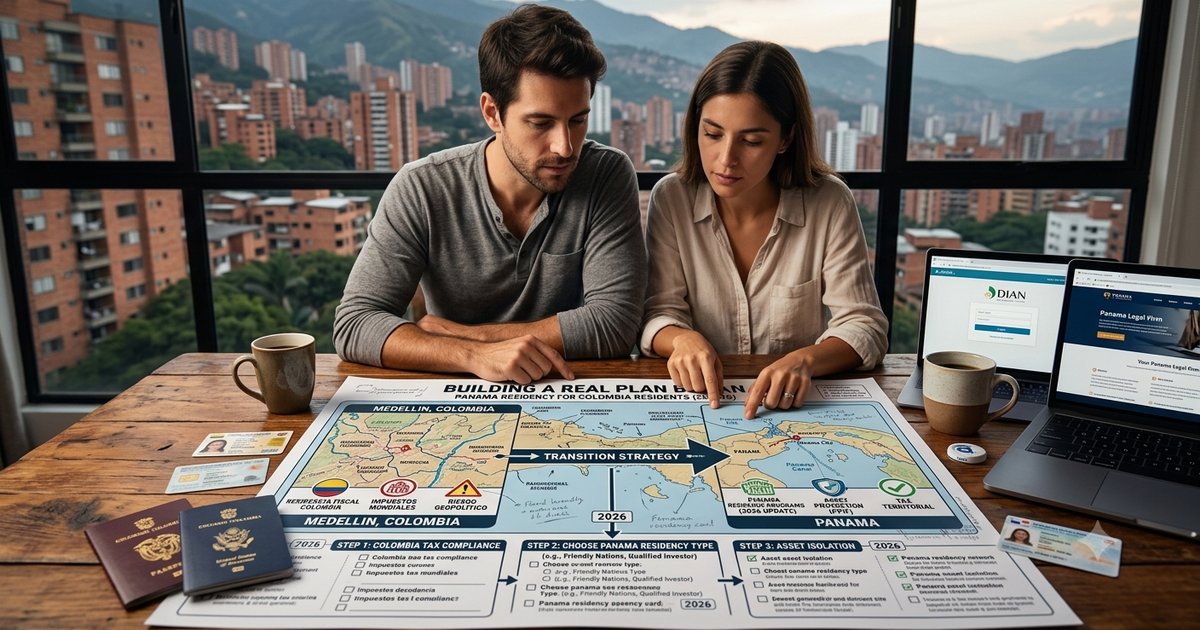
Panama runs several distinct residency programs, each built for a different profile. As of 2026, the main ones are:
- Friendly Nations Visa, open to citizens of roughly fifty countries with an economic or professional tie to Panama, historically established through employment, real estate purchase, or a fixed-term bank deposit.
- Qualified Investor Visa, created by Executive Decree 722 of 2020, granting permanent residency to people who make a qualifying investment (commonly real estate, a fixed-term deposit, or Panamanian securities) above a set threshold.
- Pensionado (Pensioner) Visa, Panama's long-standing retiree program, requiring proof of a lifetime pension income at or above a set monthly floor, paired with well-known local discounts for pensionado holders.
- A visa for people in specific professions, covering certain licensed professionals and technical roles under Panama's professional-category rules, relevant to a narrower set of applicants.
- A remote-worker or short-stay permit aimed at people who work for a foreign employer or foreign clients and want to be legally based in Panama without local employment.
Each of these has its own income thresholds, documentation, and processing path, and the exact figures and eligibility rules are adjusted periodically. This guide will not quote a specific dollar threshold here, those numbers move and a stale figure is worse than no figure. Get the current requirement for the specific program from licensed immigration counsel before you plan around it.
Why Panama and Colombia pair well
The practical reason this specific pairing comes up so often for people already living in Cartagena is geography. Panama City is roughly a ninety-minute flight from Medellín or Bogotá, short enough that maintaining a genuine, substantial presence in Colombia while also holding and using Panamanian residency is realistic, not theoretical. That is different from pairing Colombia with a residency on another continent, where the travel cost alone discourages the kind of periodic in-person presence that some programs expect.
Panama also runs a territorial tax system: Panama taxes Panama-source income, and generally leaves foreign-source income, consulting fees from clients abroad, dividends from foreign holdings, outside its own tax net. That is a genuinely different structure from Colombia's worldwide-income system once you cross the 183-day residency threshold there, and it is the reason a Panama base is often paired with careful day-count management inside Colombia, not used as a way to avoid Colombian tax residency altogether if you are, in fact, spending most of your year in Cartagena.
Managing day counts across two countries
The part people underestimate is the bookkeeping. Holding a second residency does nothing for you if you cannot demonstrate, cleanly and in real time, how many days you actually spent in each country in a given year. Colombia's residency test is a rolling 365-day window, not a calendar year, and Panama's various visa categories carry their own physical-presence expectations depending on which program you hold. Two countries means two clocks, tracked from day one, not reconstructed later from passport stamps.
Common mistakes
- Choosing a Panama visa category based on an outdated blog post rather than the current, official requirement
- Assuming a second residency automatically cancels Colombian tax residency, it does not, day count still decides that
- Not tracking days in real time in both countries and discovering a problem only after the fact
- Treating "residency" and "citizenship" as the same planning goal, they solve different problems on different timelines
- Skipping licensed local counsel in Panama because the immigration process "looks simple" online
Getting this looked at properly
Coordinating the Panama residency application, corporate structuring where relevant, banking, and ongoing compliance is the kind of work firms in this space bundle into a fixed-price engagement, delivered through licensed local partners, rather than leaving you to coordinate an attorney, an accountant, and a bank on your own across two countries. Published pricing in this space typically runs in three rough tiers: a solo remote professional wanting personal residency without a company sits at the low end; a contractor or small operator who needs a Panama company (Sociedad Anónima) alongside residency sits in the middle; and a high-net-worth individual or family wanting a two-layer company structure, a Private Interest Foundation, and family residency together sits at the top. Figures are typically in USD and exclude government fees.
Not sure which tier actually fits your situation? Tell Catalina what's going on, in confidence, before naming any specifics, and we'll point you toward the right kind of help.
FAQ
Do I have to give up my Colombian visa to get Panamanian residency?
No. The two are independent legal statuses. Whether holding both makes sense for you, and how they interact with your specific tax situation, is a question for licensed counsel in both countries.
Is a second residency the same as a second passport?
No. Residency is the right to live in and be based in a country. Citizenship, and the passport that comes with it, is a separate and usually much longer path with its own rules in every country involved.
Will holding Panamanian residency stop me from becoming a Colombian tax resident?
Not automatically. Colombian tax residency is decided by the 183-day rolling window described in Canadian Taxes from Cartagena: A Guide for Seniors, regardless of what other residency you also hold. Manage both clocks deliberately, with licensed advice.
Related reading on this topic: The Worldwide Income Trap: Why DIY Tax Answers Fail Once You Live in Colombia, When a Remote Contractor Actually Needs a Panama Company, Asset Protection and Succession Planning with a Panama Foundation.
Still have questions?¿Todavía tienes preguntas?
Catalina is our concierge. Ask her about visas, neighborhoods, healthcare, prices, anything Cartagena. She answers in chat or WhatsApp, English or Spanish, free.Catalina es nuestra concierge. Pregúntale sobre visas, barrios, salud, precios, cualquier cosa de Cartagena. Responde por chat o WhatsApp, en inglés o español, gratis.
Chat with Catalina ›Habla con Catalina ›